
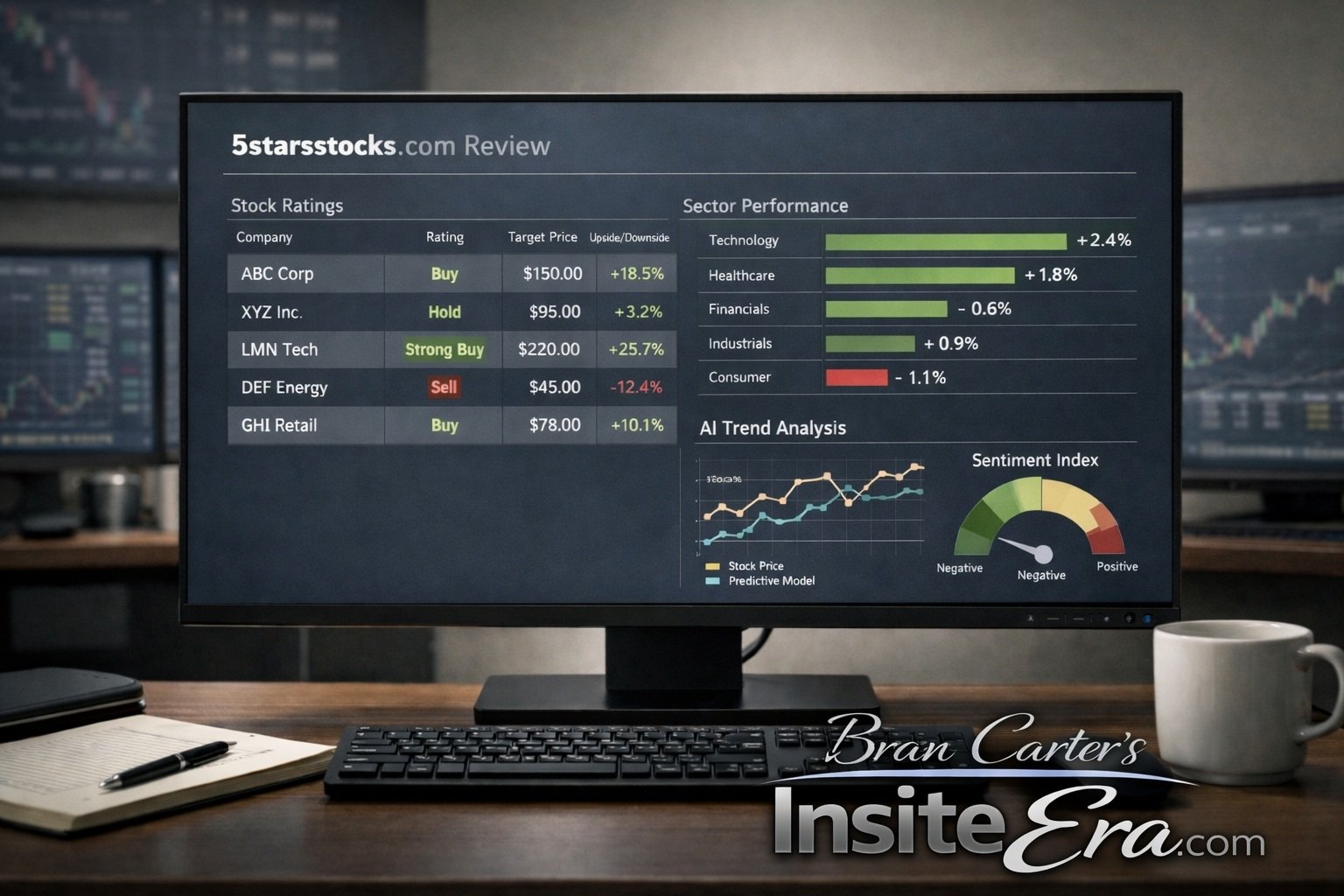

In recent months, 5starsstocks.com has appeared across a wide range of finance-related searches, from AI stock analysis to blue-chip investing and sector-specific picks such as defense, materials, healthcare, and income stocks. That visibility naturally raises a question: what exactly does this platform offer, and how seriously should investors take its AI-driven ratings?
Rather than repeating marketing claims or surface descriptions, this review approaches the platform from a practical investor’s perspective. The goal is simple: evaluate how it works, where it may provide value, where it may fall short, and how investors should realistically integrate it into their decision-making process.
Financial markets reward discipline, patience, and skepticism. Any platform that promises clarity through automation deserves careful examination, especially when it positions itself across multiple investment styles and sectors.
What Is 5starsstocks.com?
5starsstocks.com presents itself as an AI-powered stock analysis platform designed to simplify investment decisions. The central idea appears to be transforming complex financial and market data into structured ratings that retail investors can quickly interpret.
Instead of requiring users to manually analyze earnings reports, valuation metrics, macroeconomic trends, and sector rotations, the platform aggregates various indicators and translates them into summarized scores or categorized stock ideas.
The approach appears designed for:
- Retail investors seeking structured guidance
- Beginners who find raw financial data overwhelming
- Time-constrained individuals looking for streamlined screening tools
- Traders exploring thematic or sector-based opportunities
The appeal is obvious. Modern markets generate enormous amounts of information daily. Earnings revisions, interest rate expectations, geopolitical developments, inflation reports, and liquidity conditions all influence stock prices. Many retail investors struggle to process these inputs consistently.
Platforms that condense complexity into organized ratings naturally gain attention.
However, simplification always introduces trade-offs. A condensed signal can never fully replace contextual understanding.
How AI-Based Stock Ratings Typically Work
Although the precise methodology behind 5starsstocks.com is not publicly detailed in full technical depth, AI-driven stock rating systems generally rely on multi-factor quantitative models.
These models often evaluate:
- Revenue growth trends
- Earnings consistency and acceleration
- Operating margins and profitability
- Debt levels and leverage ratios
- Price momentum and relative strength
- Volatility characteristics
- Sector performance comparisons
- Sometimes sentiment-derived indicators
Machine learning systems are highly effective at identifying recurring statistical patterns in structured datasets. They can analyze thousands of stocks across multiple metrics faster than any individual analyst.
However, financial markets are not purely statistical systems. They are influenced by:
- Behavioral psychology
- Central bank policy
- Liquidity cycles
- Regulatory change
- Geopolitical tension
- Supply chain disruptions
- Technological innovation
Models trained on historical relationships may struggle when those relationships shift.
For example, valuation models built during low-interest-rate environments may misinterpret pricing during aggressive tightening cycles. Growth metrics that appear attractive during liquidity expansion may deteriorate quickly when funding conditions change.
AI excels at pattern detection. It does not eliminate macro uncertainty.
For investors, understanding this limitation is critical.
Sector Coverage: Breadth as a Visibility and Utility Strategy
One of the reasons 5starsstocks.com appears across diverse search results is its broad sector categorization. Instead of focusing narrowly, it spans multiple investment themes.
Below is a structured breakdown of the sectors it appears to emphasize.
| Category | Core Theme | Investor Profile | Structural Risk |
|---|---|---|---|
| AI & Technology | Innovation-driven growth | Aggressive growth investors | High |
| Defense | Military & aerospace exposure | Geopolitical cycle investors | Medium–High |
| Materials | Industrial & commodity-linked firms | Macro-sensitive investors | Medium |
| Blue Chip | Large-cap stability | Conservative investors | Low–Medium |
| Income Stocks | Dividend-oriented equities | Income-focused investors | Low–Medium |
| Healthcare | Pharma & biotech | Long-term thematic investors | Medium |
| Value Stocks | Discounted fundamentals | Contrarian investors | Medium |
| Passive-Oriented Stocks | Stability & low turnover | Long-term investors | Low |
This categorization allows the platform to align with varied investor interests. From a usability perspective, it simplifies exploration. Users can quickly navigate to themes that match their risk appetite or strategy.
From an analytical perspective, however, categorization is only the starting point. The quality of individual stock evaluation determines whether sector-based guidance translates into performance.
AI and Technology Stocks: Momentum and Fragility
Growth-oriented AI and technology companies often trade on expectations rather than current fundamentals. Their valuations may reflect projected market dominance, innovation pipelines, or scalability assumptions.
During expansionary monetary cycles, when liquidity is abundant and risk appetite is strong, these stocks often outperform. AI-based screening models that emphasize revenue acceleration and price momentum may produce attractive signals during such periods.
However, growth sectors are particularly vulnerable to:
- Rising interest rates
- Liquidity tightening
- Earnings disappointments
- Regulatory intervention
- Sentiment reversals
A company that appears statistically strong based on recent growth may reprice rapidly when macro conditions shift.
Investors using algorithmic scores for high-growth stocks should integrate macro awareness and disciplined position sizing into their strategy.
Data informs decisions. Risk management protects capital.
Defense and Geopolitical Sensitivity
Defense-related equities are influenced by:
- National security budgets
- Military modernization programs
- International conflicts
- Political leadership priorities
While historical revenue stability may suggest reliability, forward-looking contract flow often depends on policy decisions rather than financial ratios alone.
AI models focusing on trailing financial metrics may not fully capture the impact of sudden geopolitical developments. Investors evaluating defense stocks should supplement algorithmic signals with awareness of fiscal and political trends.
Materials and Commodity Cycles
Materials companies frequently operate within cyclical environments tied to:
- Global industrial demand
- Commodity price fluctuations
- Inflation dynamics
- Supply constraints
- Infrastructure spending
AI-driven models may effectively analyze historical margins and revenue trends. However, commodity cycles can reverse abruptly. A company benefiting from peak commodity prices may see earnings compress when supply stabilizes or demand slows.
Understanding macroeconomic conditions remains essential when interpreting model outputs in cyclical sectors.
Blue-Chip and Income Stocks: Relative Predictability
Established large-cap companies and dividend-paying stocks typically exhibit more stable financial patterns. Their long operating histories provide clearer datasets for algorithmic evaluation.
Screening for:
- Consistent earnings
- Sustainable payout ratios
- Manageable debt levels
- Stable free cash flow
is well suited to quantitative analysis.
However, even conservative categories carry risk. Economic recessions can pressure earnings. Competitive shifts can disrupt dominant firms. Dividend reductions, though less common among blue chips, are not impossible.
AI-based ratings may enhance screening efficiency. They should not replace balance sheet scrutiny.
Value Investing: The Context Question
Value investing involves identifying companies trading below perceived intrinsic value. Quantitative models often highlight low valuation ratios as potential opportunities.
The deeper question is always context.
A stock may appear undervalued because:
- The business faces structural decline
- Management credibility is weak
- Industry disruption is accelerating
- Regulatory risk is increasing
Algorithms can detect statistical discounts. They cannot always interpret qualitative deterioration.
Investors should treat value signals as prompts for investigation rather than automatic buy indicators.
Market Cycles and Model Performance
AI-driven models often perform differently across economic regimes.
In bull markets characterized by liquidity expansion and rising earnings expectations, growth and momentum-based factors may perform strongly. Historical correlations remain stable.
In bear markets or tightening cycles, volatility increases and correlations shift. Defensive positioning may outperform. Liquidity-sensitive stocks may underperform sharply.
Models built primarily on one regime may require time to adapt to another.
Investors should expect variability in algorithmic rating effectiveness across cycles.
Behavioral Considerations
Algorithmic ratings can create a perception of objectivity and certainty. Structured outputs feel authoritative.
Behavioral finance research suggests that perceived certainty can increase overconfidence. Investors may reduce independent verification when decisions appear data-backed.
Responsible use of AI tools requires maintaining critical thinking and skepticism.
Technology can enhance discipline. It cannot substitute it.
Transparency and Legitimacy Considerations
When evaluating financial platforms, transparency remains central.
Investors should consider:
- Is the rating methodology clearly explained?
- Are historical performance claims independently verifiable?
- Is ownership structure transparent?
- Are limitations openly acknowledged?
In competitive equity markets, sustained predictive accuracy above broad benchmarks is rare.
Skepticism is not negativity. It is prudent capital stewardship.
Comparison With Established Platforms
To better understand positioning, comparison with established research platforms provides context.
| Platform | Primary Focus | Research Depth | Ease of Use | Institutional Credibility |
|---|---|---|---|---|
| 5starsstocks.com | AI-based stock ratings | Moderate | High | Limited public disclosure |
| Robinhood | Trade execution | Low | Very High | High |
| E*TRADE | Advanced trading tools | High | Moderate | High |
| Morningstar | Deep fundamental research | Very High | Moderate | Very High |
The platform appears optimized for accessibility and simplified screening rather than institutional-grade fundamental depth.
Realistic Performance Expectations
No AI-driven system removes market risk. Even advanced quantitative hedge funds experience volatility and drawdowns.
Investors should expect:
- Periods of underperformance
- Sensitivity to macro cycles
- Lag during structural shifts
- Sector-specific variability
AI tools can narrow research universes efficiently. They do not guarantee returns.
Diversification, position sizing, and disciplined risk management remain essential.
Who May Benefit
The platform may appeal to:
- New investors exploring sector-based strategies
- Individuals seeking organized stock ideas
- Retail traders generating thematic research
It may be less suitable for:
- Institutional portfolio managers
- Professional fundamental analysts
- Investors requiring full methodological transparency
Used responsibly, it may enhance efficiency. Used blindly, it may increase risk.
Risk Framework for Using AI-Based Platforms
Investors incorporating AI-generated ratings into their process should:
- Treat ratings as preliminary filters
- Independently verify financial strength
- Monitor macroeconomic conditions
- Diversify across industries
- Avoid concentration based solely on model outputs
Technology should complement discipline, not replace it.
Final Assessment
5starsstocks.com reflects the ongoing integration of artificial intelligence into retail investing. Its sector categorization and AI-based scoring system aim to simplify complex decision-making.
That simplification may provide convenience.
However, markets are dynamic systems shaped by policy, liquidity, sentiment, innovation, and behavioral shifts. Algorithms operate within data boundaries. Human judgment operates beyond them.
The most resilient investors combine structured tools with independent reasoning, diversification, and disciplined risk management.
AI can accelerate analysis. It cannot eliminate uncertainty.
Technology may assist the process. Responsibility remains human.
Frequently Asked Questions
Is 5starsstocks.com safe to use?
It appears to function as a research and screening platform. Investors should independently verify insights before allocating capital.
Can AI reliably predict stock performance?
AI can identify patterns and correlations. It cannot predict unforeseen macroeconomic or geopolitical shocks with certainty.
Are sector-based recommendations sufficient for investment decisions?
Sector categorization provides context, but individual company analysis remains necessary.
Is it suitable for beginners?
Its structured format may help beginners explore investment categories, though financial literacy remains essential.
Can it replace traditional research platforms?
It appears positioned as a supplementary screening tool rather than a replacement for deep fundamental analysis.